
Ted Sablay
Las Vegas–based singer-songwriter, musical director, and teacher. Practical musicianship: melody, harmony, structure, parts, and intent.
Ted Sablay is a Las Vegas–based singer-songwriter, musician, and teacher, and the Musical Director for The Killers. His focus is practical musicianship: melody, harmony, structure, parts, and intent. He joined the band during the Sam's Town era as a guitar and keys utility player and became its Musical Director in 2022, the seat responsible for turning approved arrangements into a working live show, night after night.
That work has run through the world's biggest stages, the White House South Lawn, Madison Square Garden, Wembley Stadium, and Glastonbury, sharing them with icons such as Bruce Springsteen, Paul McCartney, and Elton John. Two decades of executing under that kind of pressure is what shapes his teaching: fast diagnosis, clear musical decisions, and repeatable systems that hold up when the stakes are real.
In 2008, two years into the Killers gig, he left touring to enroll at the University of Utah and study the sciences. While there he took a job coordinating research for infectious disease physicians, assembling literature reviews — learning the foundational work before attempting to add to it. He rejoined the band in 2012 for four more world tours. The method stayed with him.
His approach didn't come from music school alone. He holds a dual bachelor's degree in anthropology and Asian studies, and a master's in accounting, all from UNLV. He turned down a full-time offer at Ernst & Young, one of the world's largest accounting firms, to play. That framework-building instinct runs through everything he teaches. He works with students around the world over Zoom, including players at Berklee and Columbia, using the Lyric Stack, a songwriting system he built over a decade of private lessons.
He also writes and records his own music. As a solo artist he has opened for The Killers, The Wallflowers, and Chris Isaak. During the 2020 shutdown he made You'll Be Back Here Soon, a set of guitar-driven songs built for replay value. His new record, State & Motion, arrives September 25, 2026.
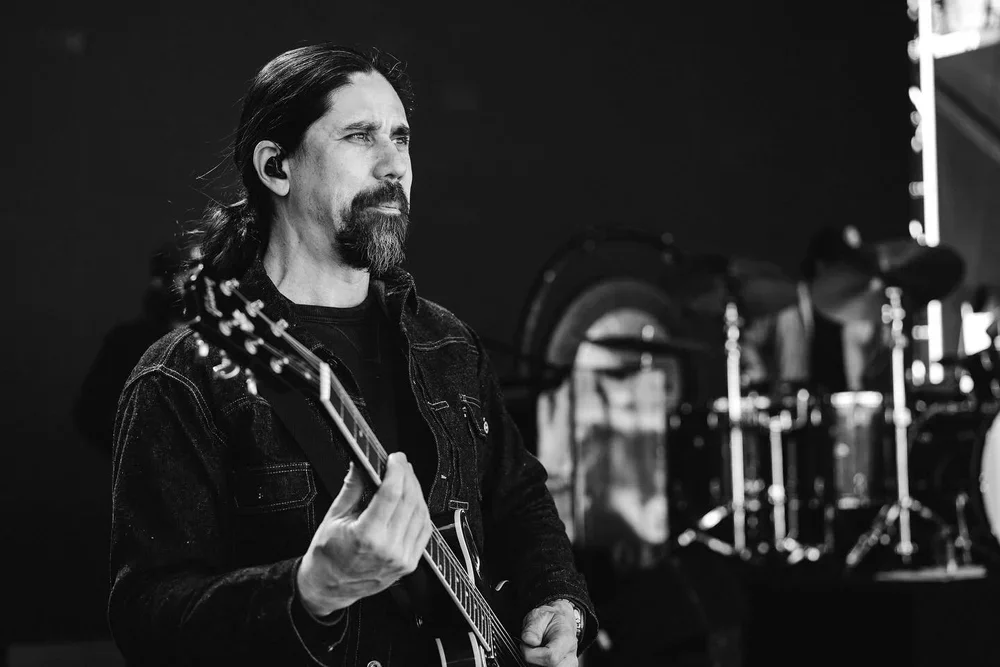
He has never had much use for the romantic idea that songs simply arrive, fully formed. If poets, playwrights, novelists, and screenwriters have spent lifetimes on how language creates meaning, a songwriter can learn from them. Drafts become rewrites. Rewrites become complete reconstructions.
He begins with music, not words — a melody, a harmonic movement, a rhythmic feel, small recurring motifs that quietly give a song its internal logic. Lyrics take months, revised until the language slides into the puzzle seamlessly.
What that looks like in practice: on Invisible Weight, the first verse once ended “you know it’s true.” He replaced it with “I want it to.” Accusation became confession. An early draft vowed to “guard that flame”; the final version reframes the whole burden as a debt — “I knew the price and bought it anyway” — and spends it down across the rest of the song.
“It might only get five percent better. But maybe that five percent matters.” Ted Sablay
- Musicianship: time, feel, listening, control
- Songwriting: melody, harmony, structure, lyric intent
- Parts & arrangement: choices that serve the vocal and the song
- Process: simple systems that create consistent progress